
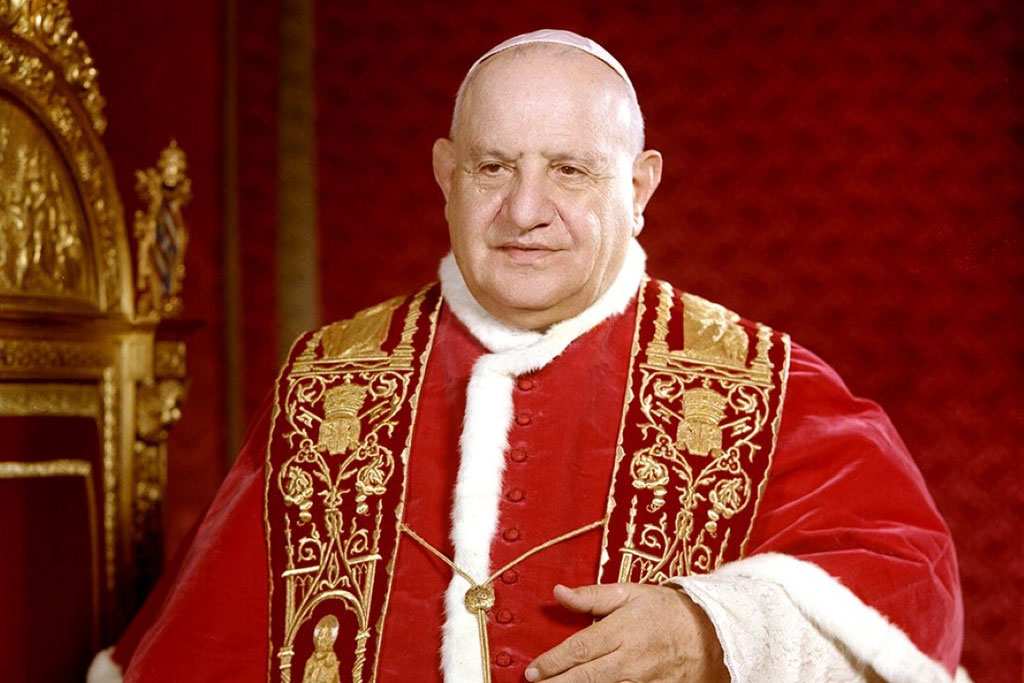

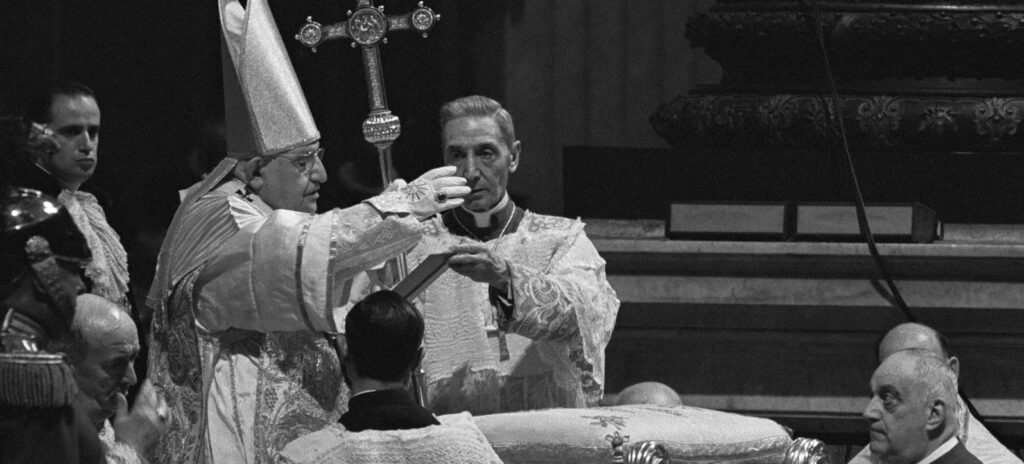
In his opening speech to the Second Vatican Council, Pope John XXIII formulated this principle: ‘What is needed is that this certain and immutable doctrine, to which the faithful owe obedience, be studied afresh and reformulated in contemporary terms. For this deposit of faith, or truths which are contained in our time-honoured teaching is one thing; the manner in which these truths are set forth (with their meaning preserved intact) is something else’.1
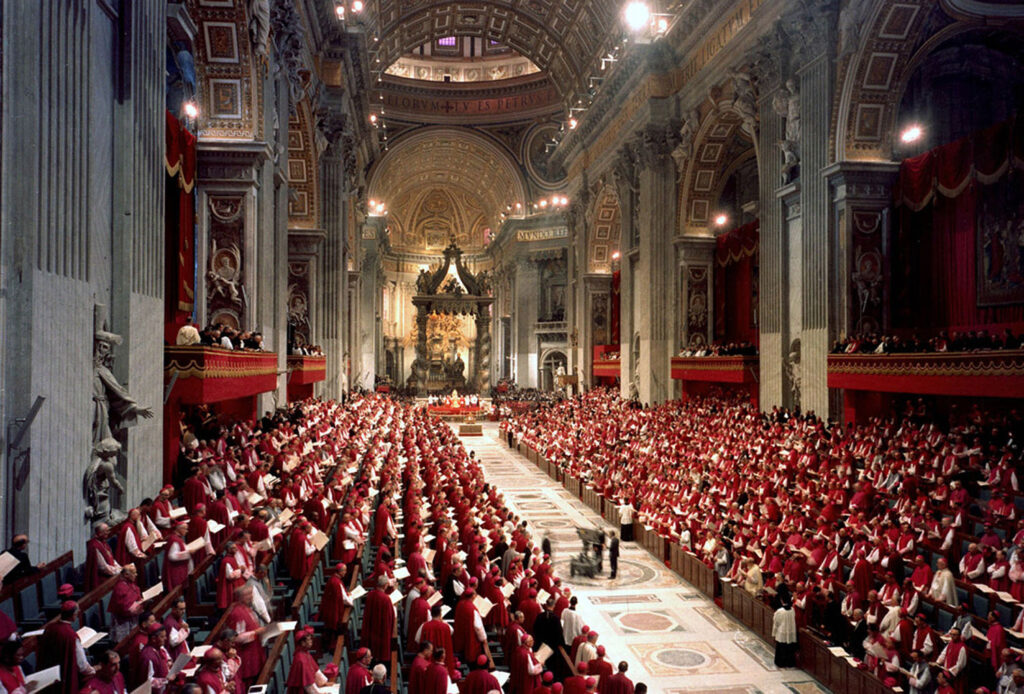
With these seemingly innocuous words, a door was opened and a process begun by which every single point of Catholic doctrine, liturgy and morality that all Catholics had been familiar with before the Council was submitted to reformulation. Virtually everything that great minds had put so much effort into articulating with great precision over a period of centuries was somehow left up to an uncertain contemporary jargon, in the hope that the same thing would be said, but in such a way as to attract and not repel the men of our time. From whichever side of the theological spectrum we place ourselves, these words, pronounced almost 70 years ago, constitute a turning point. They are the moment from which everything seemed to change, and we have all found ourselves in what can, without exaggeration, be described as ecclesiological quicksand from which there seems to be no escape.
The ‘Magic Formula’
Nor are we talking about a question as simple as that of translation. Let’s take, for example, the translation of consubstantialem Patri in the Nicene Creed. In some countries, it took decades for a correct liturgical translation to be approved, but in the end, it was. It was not difficult to resolve, though it took time due to Church politics.2 Pope John’s words refer to something very different, something beyond a question of translation. Said the Pope: It is the ‘immutable doctrine’, the ‘deposit of faith’ itself that needs reformulation, not its translation. Regardless of what Pope John meant by those words, many took them to mean that everything the Church taught now needs to be reformulated so that modern man can understand and accept it. Now, this itself hides a number of problems, for it assumes that ‘man’ and ‘modern man’ are different entities. Has a new species of man arisen in modern times? Have we reached a new stage of ‘evolution’? Or, is ‘modern man’ just so dense that he simply cannot be instructed in what the dogmatic definitions and moral teachings of the Church mean?
Furthermore, it should be obvious that any attempt at reformulating the entirety of the Church’s teaching is going to involve an infinity of texts that need to be discussed for ages on end, since it appears obvious that the ‘contemporary terms’ of today will not be sufficient for tomorrow. How can we avoid the conclusion – that should have been obvious to all the Council Fathers – that a new era was opened, an era whose hallmark would be a very talkative Church that would perhaps never arrive at a formulation that would satisfy both Tradition and the contemporary world? And how is it possible to imagine that such confusion would not cause incalculable damage, leading the entire Church to drift rudderless towards a vague religiosity that would have little to do with true Catholicism? It would take volumes to show how this ‘magic formula’ has caused virtually irretrievable damage in every area of the Church’s life. We will here limit ourselves to the realm in which this damage has been the most visible: the moral life.
Un-Pastoral Approaches
Alongside frequent affirmations from Church leaders that we must hold to the moral law as handed down to us by Tradition, 3and that this law neither does nor can change, there is a growing tolerance for what is intrinsically immoral. For example, in one breath we hear that the only place for sexual activity is within a valid marriage between one man and one woman that remains open to life, and in the next, that marriage is an ideal to strive for, and therefore any other use of sexuality – what traditional Catholic teaching refers to as the mortal sin of unchastity in its many forms – can, in a different way, show positive values and open eventually to the realisation of the ideal. One need not be a genius to perceive that this mentality cannot in any way be made to fit in with the demands of God’s law as clearly expressed in Sacred Scripture and by the constant Tradition and Magisterium, and yet, there are a number of ways in which it can be shown that it may very well flow from the ‘pastoral approach’ inaugurated by Good Pope John.
To take another example, one will reaffirm the unspeakable gravity of abortion as the murder of an unborn child that must never be tolerated in any situation and must be opposed in every way – as Vatican II did explicitly4 –, and in the next phrase speak of a ‘seamless garment’ of moral values that allows us to reduce considerably the time and energy we put into fighting the murder of children – a very difficult job indeed in the present context in which abortion is considered by many to be a human right – and leads to squandering our energies defending theses that contradict the perennial teaching of the Church – such as the absurdity according to which one cannot be considered pro-life if one promotes the death penalty. As if putting criminals to death – as God’s law says may and even must be done in some cases – and killing babies had the same moral qualification! This time, sadly, we are not even in the same ballpark. Anyone who says this is actually playing on an entirely different field from that of Catholic Tradition. And yet it is the ‘magic formula’ that made it possible.
This mentality seems to have reached a head under the pontificate of Pope Francis. In his apostolic exhortation Amoris laetitia, he wrote: ‘Conscience can do more than recognise that a given situation does not correspond objectively to the overall demands of the Gospel. It can also recognise with sincerity and honesty what for now is the most generous response which can be given to God, and come to see with a certain moral security that it is what God himself is asking amid the concrete complexity of one’s limits, while yet not fully the objective ideal’.5 Hard as it is to believe, he does seem to be saying that the human conscience can sometimes be certain that God is asking us to break His own commandments until we deem ourselves capable of obeying them.6 But of course, he was being ‘pastoral’ and not dogmatic…
Is God Still God?
It is hardly conceivable that such language would have been possible were it not for the dichotomy created by John XXIII between doctrine and its expression, between dogmatics and pastoral approaches, between the official teaching of the Church and people’s lives. With quite a few notable exceptions, it is not rare to encounter clergymen who are capable of impeccably stating Catholic dogma and moral teaching, and then condoning deviations from the moral law in the name of conscience and personal autonomy – such as allowing Catholic couples to practice contraception, or giving Holy Communion to public adulterers, or failing to challenge the scandalously immodest attire seen even in our churches.
I am not talking here about advice given in the confessional. Moralists have long been of the mind that some souls need to be brought gradually to understand the implications of the moral law when they have not yet fully comprehended its extensions, and a good confessor will take this into account when passing judgment on his penitents. What Francis seemed to be condoning was knowingly disobeying the commandments because one does not think that at a given time one can comply, and therefore God cannot want to enforce His own law in this particular case, which seems ‘equal to maintaining that in human life, situations may arise in which it is lawful not to recognise God as God’.7
One can argue that the Council itself, while repeating the principle tenets of the Catholic faith, simultaneously inaugurated an era in which one can still be Catholic but say something very different from what has always been taught, as long as one does not explicitly deny an article of faith. A whole series of theological censures that every priest used to learn about seems to have been liquidated: haeresi proxima (proximate to heresy), haeresim sapiens (savouring of heresy), error theologica (opposed to the common teaching of theologians), propositio temeraria (temerarious proposition), piarum aurium offensiva (offensive to pious ears), male sonans (subject to misunderstanding by reason of its method of expression), captiosa (a captious proposition, reprehensible because of its intentional ambiguity), scandalosa (exciting scandal). The examples of these in the past 70 years are numerous.
Of course, there are laudable efforts to explain away apparent contradictions. Sometimes they seem to succeed, but even when they do, the fact remains that the Doctors of the Church would never have condoned the idea that one must be a doctor in theology to understand the subtleties of the Magisterium’s pastoral approaches. For the Catholic in the pew, who is incapable of following the obscure reasonings of lengthy treatises, the bottom line is that the Church has changed her teaching. It seems that this was made possible only because Pope John’s ‘magic formula’ opened the door to living on two different planes at the same time. It made possible a community of believers that has all the trappings of the true Church, and even sometimes preaches the faith, but which at the same time opens its doors to whomever in conscience thinks they can be a Catholic without leaving behind a deviant lifestyle.8

Vox Clamantis
Pope John did not explain what he meant by ‘reformulating’ the faith, nor did he set any limits to this reformulation. Many prominent theologians took this as carte blanche to say just about anything, short of overt and obvious denial of dogmas of faith. Is it exaggerated to say that Pope John’s formula is the mother of all ambiguities in the post-conciliar period? It has made possible a situation in which anyone who wants to seriously discuss true reform of the Church with someone else imbued with the current Modernist mindset will inevitably find himself in a dialogue of the deaf. We are not speaking the same language, because for us, Catholics who are faithful to Tradition and consider ourselves bound by it, ‘pastoral practice’ that does not concord with dogma and flow from it is not pastoral at all. On the contrary, it is very un-pastoral to disconnect people’s lives from the truths they profess and that have been revealed to us. It is to fail them as shepherds and leave them to drift into perdition. The words of the prophet Ezekiel seem to have been written for our day: ‘My sheep were scattered, because there was no shepherd: and they became the prey of all the beasts of the field, and were scattered. My sheep have wandered in every mountain, and in every high hill: and my flocks were scattered upon the face of the earth, and there was none that sought them, there was none, I say, that sought them’ (Ez 34:5-6).
What then are we to do? Where will we find shepherds who truly seek, not to flatter the sheep with fancy novelties, but to feed them the solid truths that will profit them for salvation, at whatever cost to themselves, shepherds who actually believe that, as St Thomas tells us in the very first article of the very first question of the Summa Theologiae: ‘the entire salvation of man depends upon the knowledge of the truth’?9
Most of us can do little if anything, but if we want to see the end of the ongoing dialogue of the deaf, we need to at least not fear pinpointing the problems and calling them out. We may not be very popular for doing so, but we should be comforted by the knowledge that during what history has come to know as the Dark Ages, there were few voices that rang out fearlessly amidst the chaos, but these were later taken up by stronger voices that eventually led to the dawn of the most glorious period in Church history. Similarly, in the midst of the quasi-universal cacophony of the early 16th century, there were voices that called again and again for authentic reform, ultimately leading to the Council of Trent and the glorious period of the Catholic Counter-Reformation.
Every voice counts. Every voice that speaks the truth will be heard. One day, clarity will return to the Church, and then her children will no longer be confused and scattered, neither will there be many estranged from her bosom, because she, their Mother, will once again speak the language she taught them at the crib, the language they learned from her very lips, and that speaks of the ‘old commandment from the beginning’ (1 Jn 2:7), the words that ‘pierce the flesh’ with salutary fear (Ps 118:120), ‘that the spirit may be saved in the day of our Lord Jesus Christ’ (1 Cor 5:5).
- John XXIII, Allocution Gaudet Mater Ecclesia, 11 October 1962. Here is the original Latin of the relevant passage: ‘Oportet ut haec doctrina certa et immutabilis, cui fidele obsequium est praestandum, ea ratione pervestigetur et exponatur, quam tempora postulant nostra. Est enim aliud ipsum depositum Fidei, seu veritates, quae veneranda doctrina nostra continentur, aliud modus, quo eaedem enuntiantur, eodem tamen sensu eademque sententia’. ↩︎
- Unfortunately, the same cannot be said of the translation of pro multis in the consecration of the chalice. Here, the battle for a correct translation, if won – at least temporarily – in the anglophone world, is ongoing in many countries. ↩︎
- Of notable mention are the encyclicals Humanae vitae (Paul VI, 1968) and Veritatis Splendor (John Paul II, 1993), as well as the Instruction Persona Humana (Congregation for the Doctrine of the Faith, 1975). ↩︎
- Cf. Second Vatican Council, Pastoral Constitution Gaudium et Spes, no. 51. ↩︎
- Pope Francis, Apostolic Exhortation Amoris Laetitia, 19 March 2016, no. 303. ↩︎
- Unfortunately, the late Pontiff did not tell us how this does not fall under the anathema of the Council of Trent, Session VI, Canon 18: ‘If any one saith, that the commandments of God are, even for one that is justified and constituted in grace, impossible to keep; let him be anathema’. ↩︎
- Pope John Paul II, General Audience of 10 October 1983. The matter he was addressing was that of contraception, and his reasoning is that since contraception is intrinsically evil, to allow it in some cases is tantamount to admitting there are situations in which God is no longer God. The principle obviously applies to any action that is intrinsically evil and can never be justified, e.g. adultery, sodomy, self-abuse, public immodesty, etc. ↩︎
- In his commentary on Jn 3:19: ‘this is the judgment: because the light is come into the world, and men loved darkness rather than the light: for their works were evil,’ Cornelius a Lapide has some words that many Catholics today would find incomprehensible. He writes: ‘Today many become heretics so that they may have the freedom to follow the flesh; indeed, heresy allows for this, whereas the faith forbids it. Therefore, to convert a heretic, do this: persuade him first to live an honest life and to have chaste and holy morals; in this way, you will easily persuade him of the true faith’. ↩︎
- St Thomas Aquinas, Summa Theologiae, q. 1, a. 1, corpus. ↩︎