
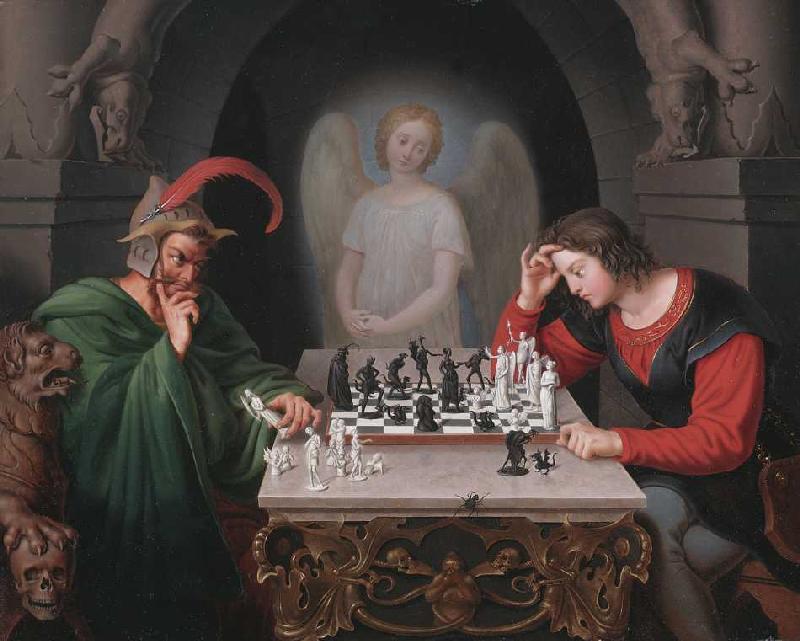

God and Daring
The SSPX’s decision to consecrate other bishops without papal approval has understandably provoked a reaction amongst traditionalists. Much commentary has focused on the legitimacy of the decision and the ecclesial context in which it was made. Issues of lawfulness, jurisdiction and doctrine have dominated the headlines. However, I think the question has touched a nerve in the traditionalist world that has not been properly explored: we too feel the need to do something about our situation. I think there is amongst our ranks the idea that, even if we do not agree entirely with the SSPX’s decision, we admire them for getting on with doing something about it. We cannot join them, but it is hard to ignore their vim and verve. Which leaves us wondering: where is ours?
The exodus that wasn’t
When Traditionis Custodes (TC) was released, many predicted a mass exodus of traditionalists to the SSPX. No doubt some felt forced to go down that path after their masses were cancelled, even after many years of faithful devotion. However, most stayed; to the annoyance of the powers that be. Not only did most stay, but our ranks have swollen too; not just despite their opposition, but precisely on account of it. To their even greater annoyance. I think many underestimated just how stubborn traditionalists can be. I think we even underestimated our own stubbornness too. We might be on occasions a cantankerous lot, but we are determined and devoted. At least that is how I pray it will be seen on judgement day.
The question still remains for us: what do we do now? Part of our problem is that as a movement we do not have a champion- something I hope for which you have been praying. (We still need one guy in the right place to do the right thing.) Locally, many are still doing their best and offering faithful service. Globally, we are still dependent on curial officials and the machinations of court. The fidelity required of us in this moment requires much confidence in Divine Providence. We are in good hands. But in uncertain times.
Our next step however, is not entirely obvious. In part, this is because we have never been a universal movement in the Church. Up until quite recently, we were a rag-tag bunch begging the local ordinary for a priest and an altar. If you were one of the luckier ones, you were tolerated in the hopes that you would eventually go away. Then something changed. Even if we were hurt, TC actually made us a universal priority. What had been seen as a local matter has now become a matter for the universal Church to ‘sort out’. Our ‘popularity’ as it were, has certainly come at a price. A price, please God, that will be worth paying for our children and our children’s children benefit. We are on the map– even if they are using the map to try and bomb us off the face of it. But here we are- still standing. By the grace of God.
So, in the meantime there is something that we must do. Something that I think has been stirred up by the SSPX’s decision: that is, we must pay attention to how traditionalism shapes the culture and how it must shape the intangibles of the next generation. Let me explain.
The cultural crush
You cannot outrun the culture. It is the air that we breathe. It is the ideas that are acceptable in ‘polite’ company; it sets the expectations about how you should behave in that company. It is that ‘feeling’ you have about whether people accept you or not- or think your ideas are ‘strange’, ‘racist’ or completely bonkers. Try as you may, you cannot avoid the influence culture has over your life. To ignore this, is not merely to try and swim against the current; it is rather like trying to swim after jumping out of a plane in mid-air. There is nowhere for you to go but down.
That is why Catholicism is a religion that creates culture. Christianity has, from its very first moments, been present to the world by shaping and transforming the culture of the world. We think of Christian culture as Christendom. And no doubt this is true. But Christendom was a high point of Christian culture- it does not exhaust Christian culture. At least not as far as it expresses itself in all ages and at all times. Christendom is wherever Christian culture is being created. It is in the Low Mass celebrated by a monk in his monastery before sunrise. It is in the family hearth fire as father reads stories of the lives of the saints to his children. Christendom has certainly its apex and its marvels- but Christendom is not just in those moments: it is in each moment that makes up those moments. And this truth is precious to us now as we contemplate a renewal of the Church and the civilisation that She created. But knowing this is not enough.
A movement on the move
Traditionalism as a movement, has certainly changed over the years. I think that a visible maturation has taken place as we have had time to digest, pray, and experience the depths of the treasures to which we cling. And we give thanks to God for such blessings- it is a sign of his faithfulness to us. However, we still have much work to do in order to bring the rest of the sons of the Church along with us. We may be a universal reality, but we are still very much a minority. And whilst soever traditionalism is in the minority, the majority will be both lost and scattered.
So, how does traditionalism navigate this moment as we scale from small communities and local realties into a movement for the entire Church to embrace? What is our next step in order to overcome not just the world, but the modern mess of the church.
A little housekeeping
I am personally opposed to the idea of a traditionalist personal prelature. It might actually make life a bit easier for some of us, but at a cost to our future I do not think we should incur in the present. I think the recent experience of TC has taught us that trying to put traditionalism in a ghetto where it can wither and die is a sure path to failure. Not for the TLM, but for those who wish it harm. A personal prelature would be for us a kind of gilded ghetto. Traditionalism is about re-establishing the Tradition as the First Virtue of the Christian life- the norm of norms;1 this you cannot do from behind closed doors.
Some of you may disagree. And that is fair enough. I just do not believe that this is the direction the Lord is actually leading us. At least right now. I think He is being more demanding on us; asking us to put aside our personal desires in order that future generations may be spared the mess others have created. The sacrifices we make today will be for the benefit of those who come after us. Traditionalism has spent much time discerning what riches have been handed to us; we must now make sure we are handing them on to those who come after us. Our movement is for souls- not self-preservation.
So, what is our next move?
The next step is for us to learn to do something explicitly and intentionally that we have been doing instinctively and implicitly: to capture the Catholic imaginary. And in order to do this, we must paint a compelling picture of the future of traditionalism; for this is how we capture the hearts and mind of future generations. And this means learning to speak to the present about the future in the words of the past. Let me explain.
A new language for an ancient mission
As traditionalists, we live with one eye on the past because we know there is wisdom there. We don’t live in the past, and neither should we dwell there; as that would mean playing make believe in the present. Today must be today. But it cannot be today without both a love for what brought us to this moment as well as a consideration for the moments that come after it. To be a traditionalist means to live in the present with gratitude for the past and with benevolence towards the future. How does one do that?
The most effective way of doing something like that is to be able to capture and speak into the imaginary. And in particular, the catholic imaginary that exits in every catholic soul. The imaginary is not a place of make believe and fantasy. The imaginary is where we perceive the immaterial truths of reality. The imaginary is the sense organ of the soul. A place where things that can’t be captured by the physical are perceived and become real for the human person. The imaginary is where we perceive the presence of God and the moral order. It translates the immaterial aspects of reality- the transcendentals- into categories that make sense in our interior life. It is also that place where we recognise evil in the world and in ourselves. If not properly formed, it can also be that place where we summon evil actions. If the imaginary is not brought under the dominion of God, it becomes that place where we conjure up ideas of being His equal; or worse, His replacement.
But the imaginary requires much work in order to form it well. And we know this implicitly because of our love for the TLM. When people object to the TLM because you “can’t see the priest’s face” or “can’t understand what the priest stays” we immediately know that the Mass is not an exercise in understanding, rather it is an action of perceiving. The TLM is not trying to inform us about God, but rather conform us to Him. What is formed in our presence at the TLM is our internal perception. We are made aware of things invisible because our imaginary- our internal sense organ- in enlivened by those visible treasures wisdom has bequeathed to us. The TLM- its Latin, ad orientem worship and chant- may be beautiful, but that beauty is not about our preferences for it. Rather it mediates the Divine to the material world in the language of the soul. This is why the TLM transforms- it does not ‘inform’. Much more is happening at the TLM than our physical senses can absorb.
The burden of the modern
But the modern world is unable to understand that language because its imaginary has been corrupted. And it has been corrupted in a way that only tradition itself can restore.
The temptation that we face in the modern period is the opposite of what the tradition is. Tradition looks to give the past a place in the present so that it can be handed on to the future; whereas the modern tries to give the future a place in the present so that it can replace the past. The modern period is always trying to make us chase a future that does not exists and ignore the wisdom of things that have gone before us. We just need to think of those things that consume our attention. Our pathological fear of the weather means that we are terrified of things that have not happened and which have done no damage to anyone as a reason to inflict great suffering on ourselves in the present. But in order to inflict this on ourselves: we must ignore lessons from the past. The human spirit finds ways of overcoming- we are not victims of the world, but its steward.
As traditionalists, we need a way of speaking about the future of traditionalism that captures the imagination without resorting to the histrionic. We want to capture hearts and minds, not panic. That is not imagination- that is manipulation. This means finding a captivating way of speaking about traditionalism’s future and what the future will look like. I know that in times of confusion, dwelling in the past can seem appealing. The past looks a lot more like reality than an uncertain present- but it is not our way. And it is certainly not what our next move must be. Next article we will look a little more at what such a future might look like and how we might prepare for it.
- I am indebted to Dr Kwasnieski for this term. I want to give him the credit for that expression. ↩︎