

By Fr Thomas Crean (St Dominic’s – 15th June, AD 2024)
In the sixth month, the Angel Gabriel was sent from God into a city of Galilee, called Nazareth.
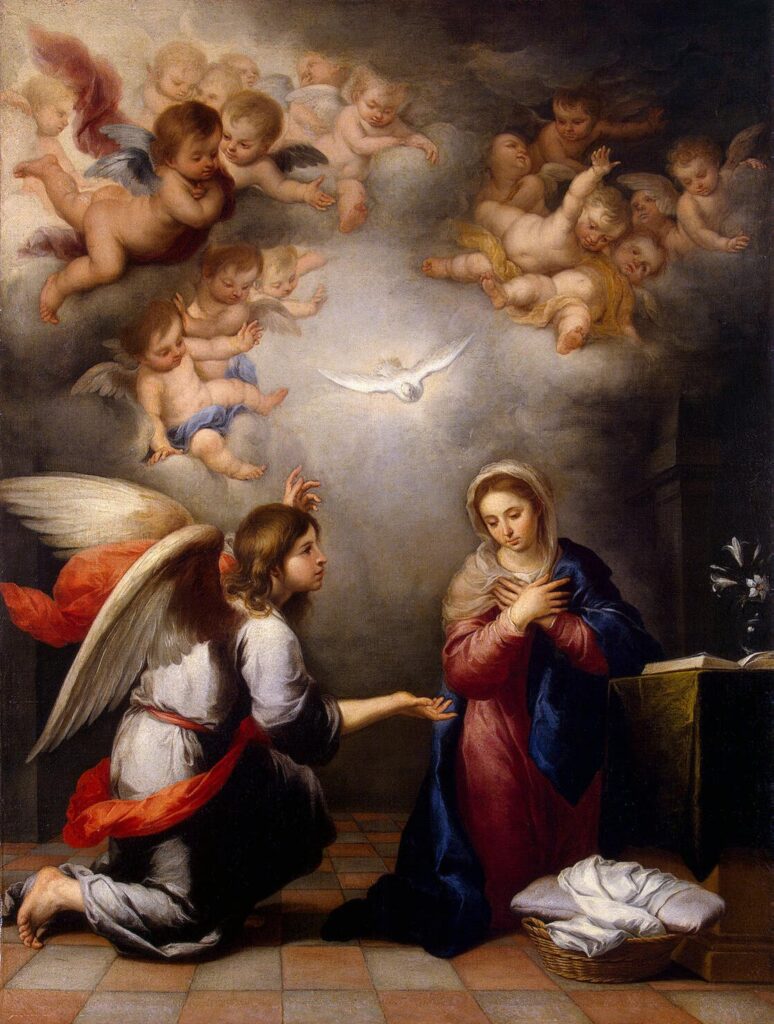
In my first talk today, I want simply to think about what is certainly one of the most important conversations that has ever occurred: I mean the conversation that took place between the Blessed Virgin Mary and the angel Gabriel when the latter had been sent by God into the town of Nazareth. It may be that St Luke has given us only the summary of a much longer conversation: Venerable Mary of Agreda, for example, in her remarkable book The Mystical City of God, which was based on her own visions and locutions, tells us that St Gabriel entered the house of Nazareth in the evening and spoke to our Lady throughout the night concerning all the prophecies of the Old Testament which Jesus Christ was to fulfil, before leaving in the dawn of the next day. However that may be, we can be sure that every word in the conversation as reported by St Luke is worth scrutinising, not only because everything in Scripture is worthy to be studied, but also for another reason: each of the speakers said to the other exactly what God wished to be said. The angel spoke in perfect accord with God’s will, because the holy angels see His face and are His messengers, and can have no desire to say anything except for what they see that He bids them say; Our Lady spoke in full accord with God’s will because even though she was then still living by faith not by sight, she was always moved by the Holy Spirit who dwelled within her to say what was fitting in all the circumstances of her life, however strange or unforeseen.
This conversation, then, begins with the angel’s entering the house of St Joseph and saying to Mary: Hail, full of grace, the Lord is with thee: Blessed art thou among women. Notice that word ‘hail’, first of all. In the bible, it is not used in the Bible as a casual greeting. In fact, up till this point in the bible, it has always been used by a prophet speaking to some city or people, but personified as a woman. Think of the prophet Zechariah, speaking to Jerusalem, and saying to her: Hail, daughter of Zion. So, it is not by chance that the angel uses this form of greeting. True, he is not addressing now a city or a people personified as a woman. He is addressing a woman herself; but this woman, Mary, is one who represents the whole people. She is herself, in the phrase of Mary of Agreda, the mystical city of God. And so St Gabriel says to her, hail. It as if to say, “O Mary, you alone are worthy to be called daughter of Zion; you alone are a true Israelitess.”
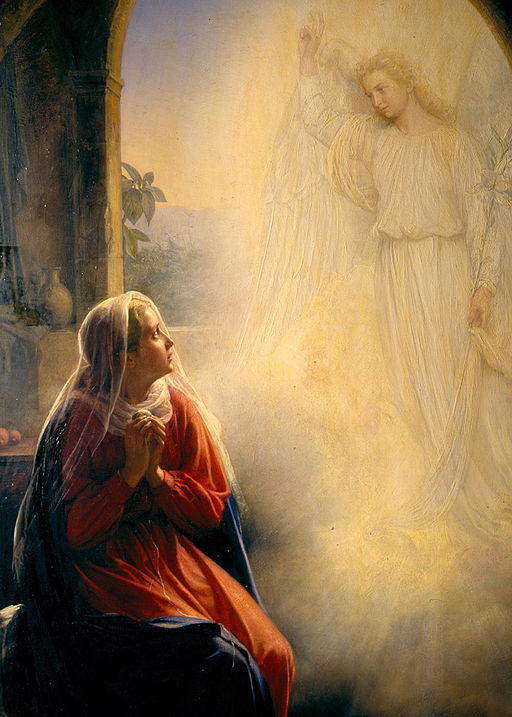
He adds, Full of grace. In Greek, which is the language in which St Luke wrote his gospel, this phrase ‘full of grace’ is just a single word, kexaritoomenee. It is a description, first of all, but it is also serves as a name. As we might say to a friend, ‘Greetings, John, or Peter’, the angel says to her ‘Hail, kexaritoomenee.’ Does this remind you of anything? To me, it is reminiscent of how at Lourdes, when the Lady had appeared to St Bernadette on several occasions and was asked her name, she finally answered by saying, “I am the Immaculate Conception”. The grace that God had given her was so present to our Lady’s thoughts that in speaking to St Bernadette, she let it serve as her very name. Here too, the angel uses kexaritoomenee, ‘graced one’, as Mary’s proper name and title.
He goes on, the Lord is with thee. It is not the first time that an angel had used these words to a human being. If you have read the Book of Judges in the Old Testament, you may remember that when God wills to deliver the people of Israel from the Midianites, He sends His angel to a young man called Gideon, who is threshing wheat. The angel says to Gideon: The Lord is with thee, O most valiant of men. It is a strange juxtaposition: all that Gideon is doing is preparing his father’s wheat for grinding into flour, and yet this angel of God addresses him as ‘most valiant of men’. It’s not by chance that St Gabriel uses the same words to Mary. As the young man Gideon was preparing wheat, so she is going to bring the Bread of Life into the world. As Gideon was put to flight the hosts of Midian, even though he says to the angel my family is the meanest in Manasseh, and I am the least in my father’s house, so our Lady, though she is so lowly in her own estimation, because she is so lowly in her own estimation, will be to the devil and his host as terrible as an army set in battle array.
He goes on: Blessed art thou among women. St Elizabeth will repeat these words at the Visitation, and I’ll say more about them this afternoon. For now we can say that it is perhaps these words more than the others that caused Mary to be troubled at the angel’s greeting. The first part of the greeting, I think, would have disturbed her less. She knew that the Lord was with her since she knew that she had faith in Him, and she also knew at least some of the graces that she had received from Him; but to be told by an angel that she was blessed among women – which could only mean ‘holiest among women’, since an angel was not going to rank fame or wealth or anything else above holiness – would have troubled her humility. And so, she does not greet the angel in return, since that would have seemed like accepting the praise, which her humility prevents her from doing, but nor does she protest against his words, since she knows in her prudence that angels do not err. Therefore, she remains silent, and thought with herself what manner of salutation this might be.
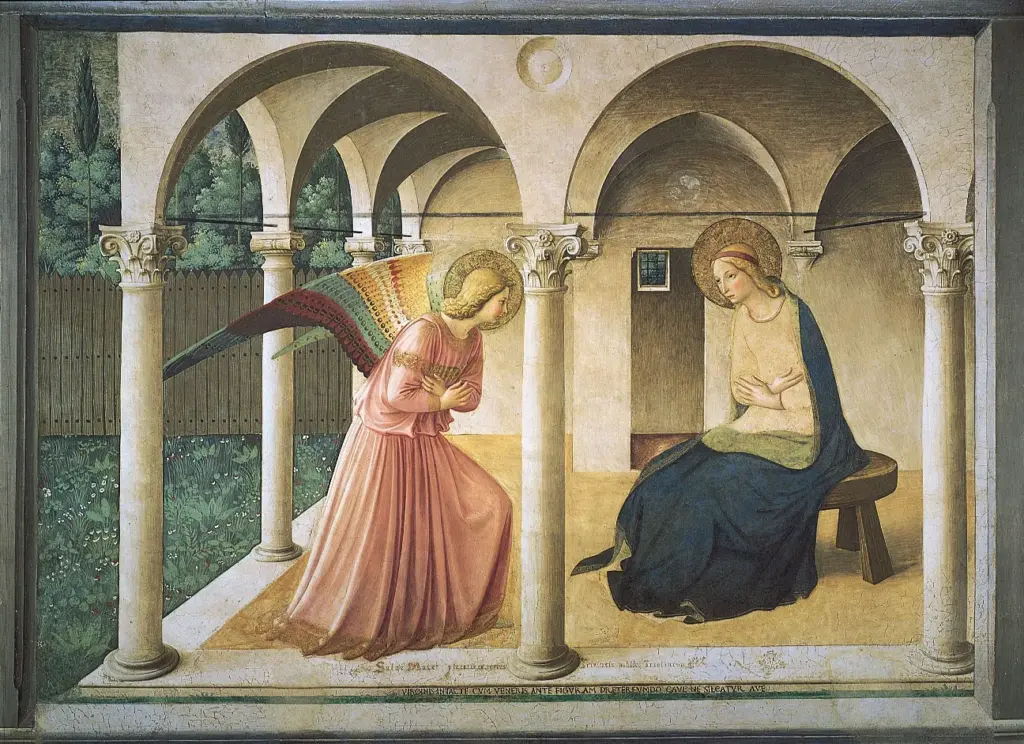
The Angel said to her: Fear not, Mary, for thou hast found grace with God. The fear that had to be taken away was not, I think, so much fear at an angelic apparition: we are not told that she was troubled at seeing an angel, but simply at his saying. She feared to accept his words, Blessed among woman, in case by doing so, she might injure her own humility. Therefore the angel reassures her: Thou hast found grace with God. It is as if he is saying: “Do not think that in calling you blessed among woman I am inviting you to exalt yourself; rather, since it is God who has given you this grace of holiness, my words need not threaten your humility.”
Notice that this time St Gabriel calls her by her name. He says, Fear not, Mary. I think it is the only time in Scripture when an angel on earth addresses a human being by his or her name. The angel who came to speak to Gideon didn’t do that. Nor did the angel who appeared to Joshua, son of Nun, or the one who appeared to the parents of Samson. Even in the New Testament, when an angel comes to release the prince of the apostles from his prison, he doesn’t say, “Fear not, O Peter”. He strikes him on the shoulder and says “Arise quickly”, not using St Peter’s name. And in the Apocalypse, when St John falls at the feet of the angel to venerate him him, the angel simply says, See thou do it not; he doesn’t call him ‘John’. These angels did not have enough in common with the human beings to whom they spoke for it to be fitting for them to use the human name. But here, St Gabriel says, Fear not, Mary. Again, it is to reassure her; as if to say, you are not below me, though by nature you might seem to be. It is also, I think, to teach us to honour her name. And so, while the Church has no feast of the name of Peter or the name of John, she does have a feast of the most holy name of Mary.
Behold, thou shalt conceive in thy womb, and shalt bring forth a Son, and thou shalt call his name, Jesus. Why does he say ‘thou shalt conceive in thy womb’? Where else, we might ask, could a conception take place? Is it just an idiom? Yet nowhere else in Scripture do we find this phrase, ‘thou shalt conceive in thy womb’. Why is it used here? I think it is to show no external power on earth will bring about this conception: this conception will be entirely internal; it will happen by God acting directly upon the virginal womb of Mary.
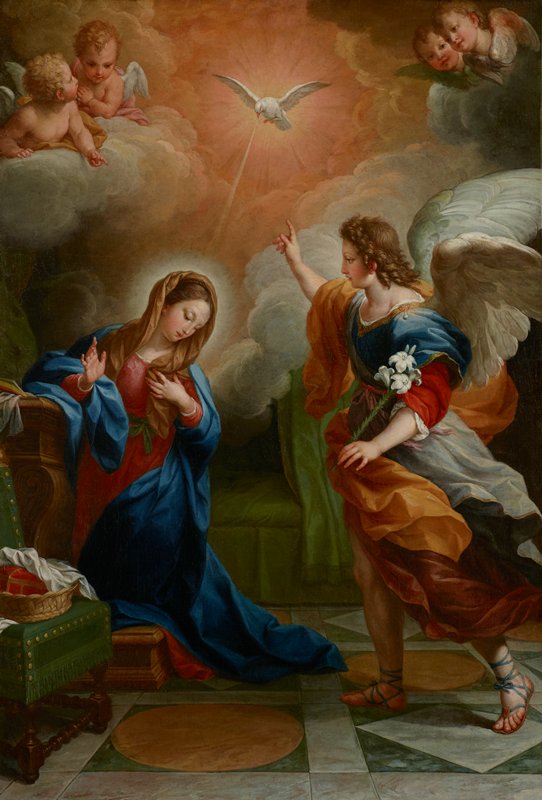
Here we have reached the heart of the Annunciation: thou shalt conceive in thy womb, and shalt bring forth a Son, and thou shalt call his name, Jesus. Our Lady already knew of the Blessed Trinity; she knew that the second Person was to become incarnate. Yet now it is as if she is being introduced to Him for the first time. She learns His name, Jesus. At the time, this was not an unusual name. Just as when He made Himself our food in the Blessed Sacrament, the Lord employed bread and wine, which was the common nourishment of that time, so also when He became incarnate, He chose a name that was in common use. Yet surely, this name now strikes the ears of our Lady differently from how it has ever done before. When she hears St Gabriel say, thou shalt call his name, Jesus, she finds that God has infused a new grace into this name, to make it the most beautiful of names, as the one who bears it will be, says the psalmist, beautiful above the sons of men.
How does the angel continue? To St Joseph, after revealing the name of God incarnate, he had gone on to explain its significance, saying for he shall save his people from their sins. But the angel does not say this to Mary. He doesn’t speak to her of sins, since neither he nor she has ever known sin. Instead, he praises her Son. He shall be great, and shall be called the Son of the most High. Notice how carefully he speaks. He doesn’t say, ‘He shall be the Son of the most High’, in case that might make us think that He wasn’t already the Son. He says, He shall be called, foretelling not the future glory of the Son, but mankind’s future faith in Him.
But why mention David and Jacob? The Lord God shall give unto him the throne of David, his father: and he shall reign in the house of Jacob for ever. Isn’t Jesus going to be king of all the nations? Yes, but Mary was descended from David, as was Joseph also; to mention David is also a way of honouring both her and her spouse. To mention Jacob recalls the promises that God made to the patriarchs, that the Messiah would come from their seed. But lest those old Testament names should give us too limited an idea of Christ, the angel goes on, and of his kingdom there shall be no end. It is as if to say openly, “Your Son will be the God of Israel”, for who else has a kingdom without any limit of time or power?
And Mary said to the Angel: how shall this be done, because I know not man? I do hope that none of you has a bible that makes our Lady ask, “how shall this be done because I have no husband”. She did have a husband, St Joseph. God would not have sufficiently protected the honour of our Lady if she had conceived before marriage. She is referring, here, to her vow of virginity. So, she asks: How shall this be done? But didn’t she know what Isaiah had prophesied, that the Virgin will conceive and bear a son. Yes, she knew it; but Isaiah had not foretold how this would happen. So, she asks the angel to explain to her what the prophet had left undescribed, as being something too great for the Old Testament.
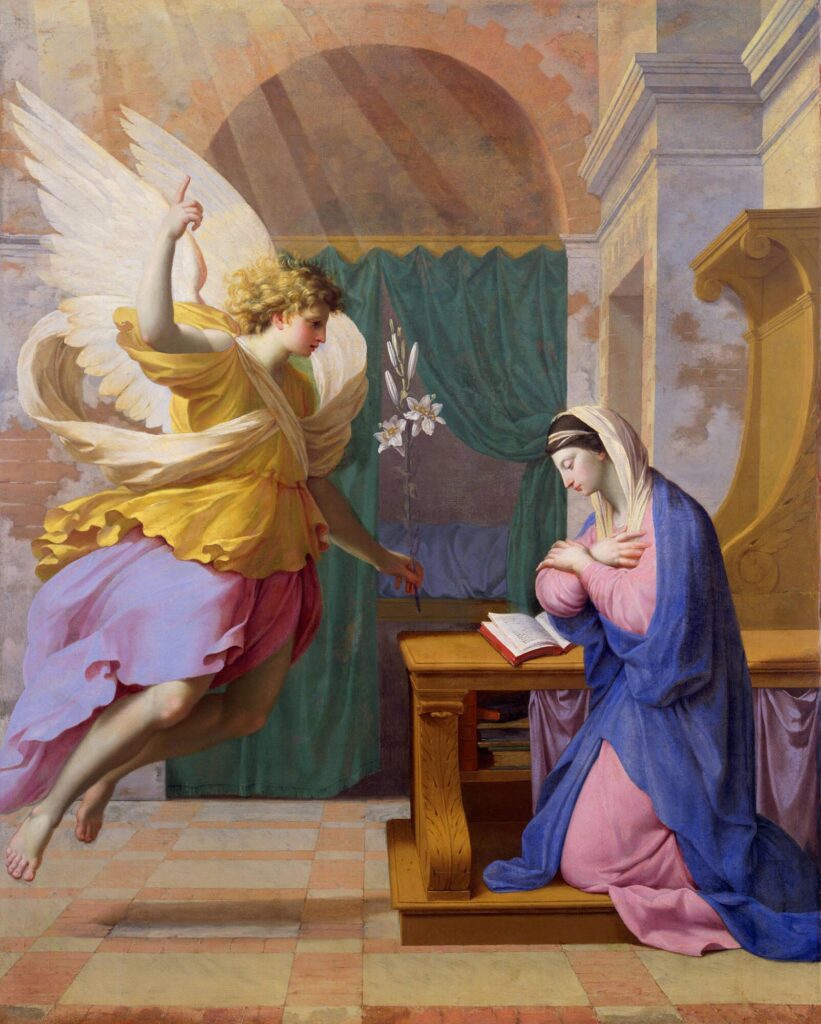
And the Angel answering said to her: the Holy Ghost shall come upon thee. Isaiah had not said this. Nor had he said what comes next: The power of the most High shall overshadow thee. The prophet had simply foretold that a virgin would conceive. Now we learn that this virgin is to be the bride of the Holy Ghost.
Therefore the Holy which shall be born of thee. We can also translate St Luke’s words: “That which shall be born of you in a holy way”, and then they will refer our Lady’s virginity in child-birth. As the ray of light passes through crystal, say the Fathers, so the Son of God came into the world. The Holy which shall be born of thee shall be called the Son of God. He is already the Son of God. But He will be called so by men who know that He is born from the Virgin by the power of the Holy Ghost. One day everyone will recognise this. For now, there are those who say that He is born of the virgin but don’t yet know that He is the Son of God; these are those whom we call the Muslims. May she obtain for them the light to believe in her Son.
The angel finishes by speaking of the child whom Elizabeth had conceived in her old age. Not that our Lady needed reassuring about the power of God, since she already believed his words. But this new revelation is a reward for her faith. And the more we believe in God, the more He will reveal to us. But lest the ease of Mary’s faith should lead us to neglect the greatness of the mystery, he solemnly declares: No word shall be impossible with God. It seems to me that we hardly believe in the incarnation of the Word, unless we sometimes ask ourselves, “but how is it possible? How is it possible that God should become a man, and that a man should be God?” It is then that we may have recourse in faith to Gabriel’s final message to our Lady and to ourselves: No word shall be impossible with God.
As was fitting, the angel leave the final word to his queen. What is that final word? Behold the handmaid of the Lord. Let it be done to me according to thy word. “She calls herself the Lord’s handmaid”, says St Ambrose, “who had been chosen as His mother.” So, she finishes where she began, in her humility. And the angel departed from her, not presuming to stay beyond his appointed time.